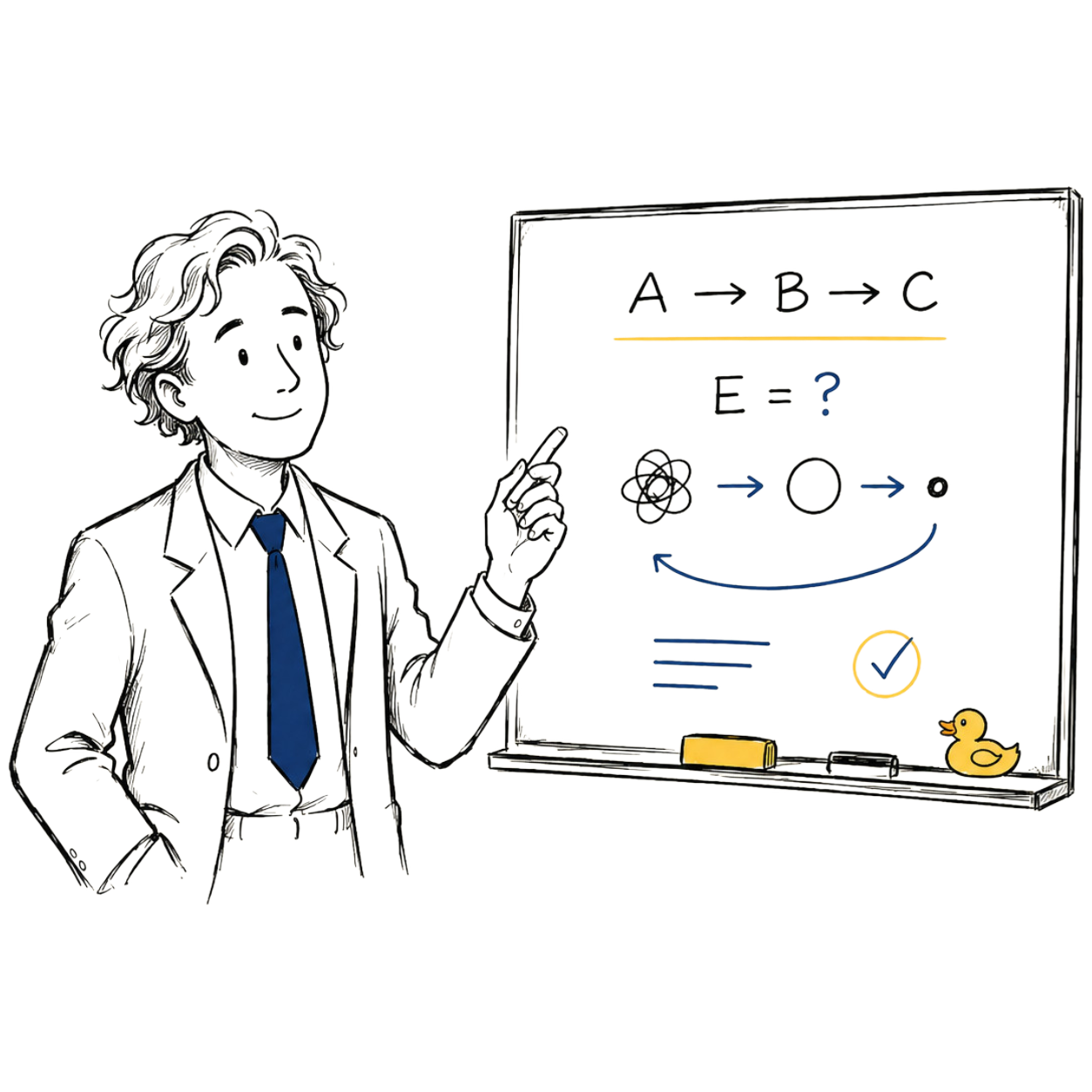
You've studied for hours. You still can't explain it.

Explain the concept to your AI duck. Feynduck finds exactly where your understanding breaks — and fixes it before the exam does.

Feynduck AI study companion hero illustration

Loved by students from

HarvardYalePrincetonColumbiaBrownDartmouthCornellUPennMITStanfordCaltechMcGillUC BerkeleyUCLAUniversity of TorontoOxfordCambridgeHarvardYalePrincetonColumbiaBrownDartmouthCornellUPennMITStanfordCaltechMcGillUC BerkeleyUCLAUniversity of TorontoOxfordCambridge

Why Feynduck works.

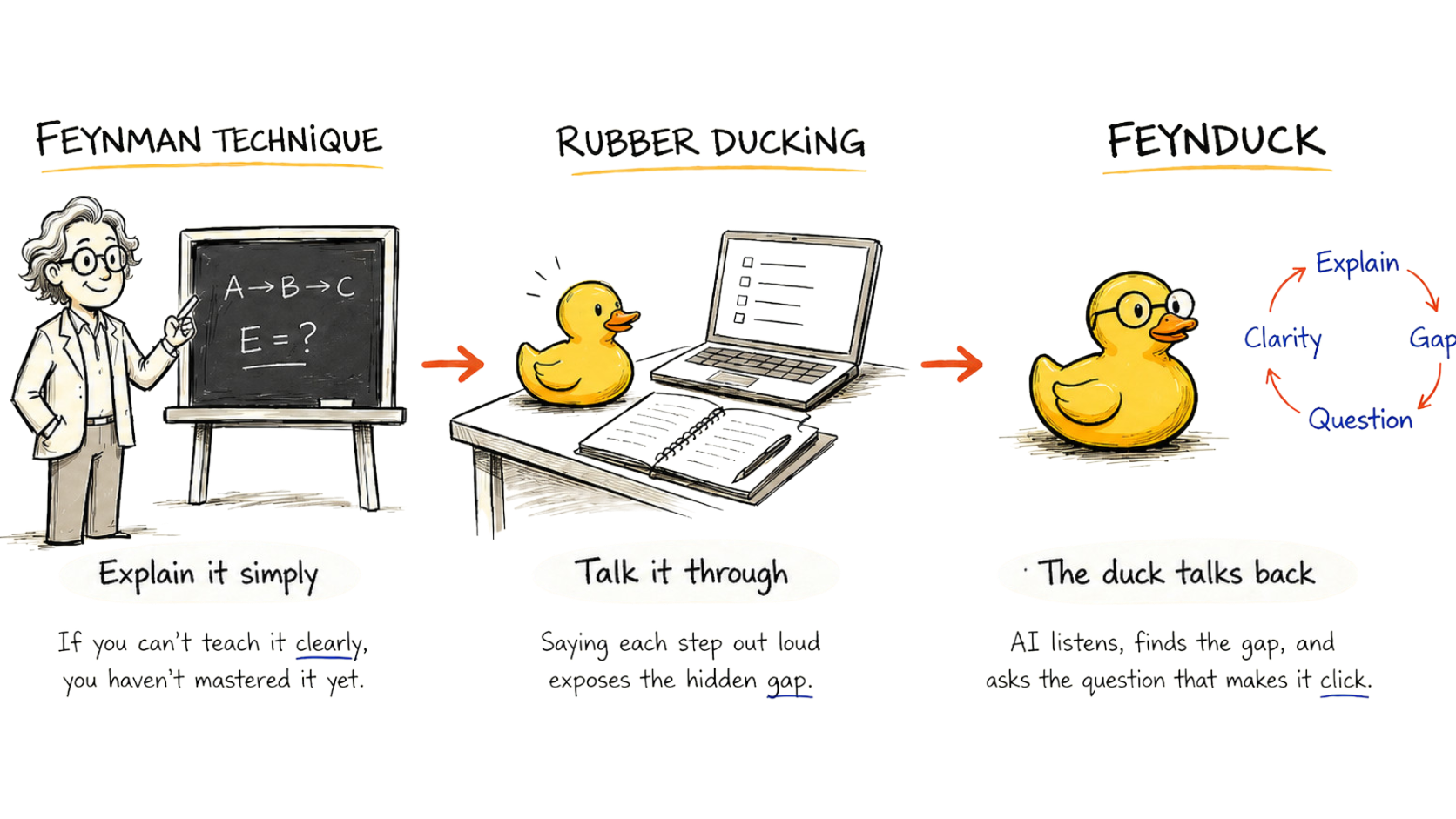
Feynman helps you explain. Rubber ducking helps you hear the gap. Feynduck helps you fix it.

feynman technique

/fyn-man tek-neek/ · noun

definition.

A learning method built around one test: can you explain a concept in plain language, as if teaching it to someone who knows nothing? If you stumble, that stumble is the gap.

named after · Richard Feynman

see also · active recall, teaching to learn
rubber ducking

/rub-er duk-ing/ · noun

definition.

The act of explaining a problem step by step to an object. The duck never responds. The explaining forces vague thinking into clear steps.

origin · The Pragmatic Programmer

see also · self-explanation, metacognition

feynduck

/feyn-duk/ · noun

definition.

The duck that talks back. An AI study companion that makes you explain a concept in your own words, finds where your reasoning breaks, and asks the one question that helps you fix it yourself.

see also · understanding, not memorisation

Feynduck workflow diagram

Explain it to your AI duck. Find out what you actually know.

No passive rereading. No pretending a highlighted paragraph means you learned it.

Step 1

Upload your material

Drop in your lecture notes, slides, a PDF, a YouTube video, or just paste a link. Feynduck reads it so the feedback actually matches what your class covered.

Step 2

Explain it to your duck

Pick a concept and explain it out loud — like you're telling a friend who's never heard of it. Don't worry about getting it perfect. That's the point.

Step 3

Fix the gap together

The duck tells you exactly where your explanation broke down or went wrong — where and why. Answer one follow-up question, then try again. That's the moment it actually clicks.

See Feynduck in action.

Upload notes, explain out loud, find the gap, and track what you can actually explain.

Krebs Cycle — Biology Midterm · Feynduck
Feynduck
HomeMy ExamsProgress
Upload materialDrop PDF hereAttach to: Biology Midterm
BIOLOGY MIDTERM · KREBS CYCLE

Detected topics

One session can turn vague recognition into a real explanation.

Before

“The Krebs cycle makes ATP and oxygen is needed for respiration, so I guess oxygen keeps it going.”

Sounds right. Feels complete. Clarity Score: 34.
After one session with Feynduck

“The Krebs cycle doesn't use oxygen directly — but it produces NADH, which carries electrons to the transport chain. Oxygen sits at the end of that chain accepting those electrons. No oxygen means NADH can't offload, NAD+ runs out, and the Krebs cycle has nothing left to work with. It doesn't stop because of oxygen — it stops because of what oxygen's absence causes downstream.”

Same student. A few minutes later. Clarity Score: 87.

Built for students who can't afford fake confidence.

Feynduck is for students who put in the hours but still feel unsure when they have to explain, reason, or apply the material.

Exam-heavy students

You study hard, but freeze when the question asks “why?”

Pre-med & science students

You memorize mechanisms, but need to explain causal chains clearly.

CS & engineering students

You follow examples, but need to reason through the underlying logic.

Students using AI to study

You get summaries and answers, but still need to prove you understand them.

Start free. Upgrade when Feynduck becomes your study habit.

Try the explanation loop for free. Upgrade when you want unlimited practice, deeper gap feedback, and study history across subjects.

Free

Try one real Feynduck session

$0/ month
  • 1 guided explanation session
  • Upload 1 PDF, notes file, or pasted link
  • Practice 1 concept from your material
  • Basic gap feedback
  • 1 follow-up question per session
  • Preview your first Clarity Score
  • Upgrade to keep practicing
Start studying free
Best value

Scholar

For med school, law, research

$15/ month

billed $180/year — save $60

  • Everything in Student
  • Unlimited PDF uploads, up to 100 pages each
  • Mastery Map across all exams
  • Unlimited active exams
  • Export gap reports and session notes
  • Priority processing
  • Early access to new features
Start Scholar

Questions students usually ask.

Feynduck is built around explaining, not passive rereading. Here's how it works.

The Feynman Technique is a learning method based on a simple idea: if you can't explain something clearly in plain language, you probably don't understand it yet. You choose a concept, explain it as if teaching someone else, find the gaps, then simplify it with clearer words and analogies.

Rubber ducking comes from programming. Developers explain code step by step to a rubber duck to spot mistakes in their own logic. The duck doesn't need to answer. Explaining forces vague thinking into clear steps.

No. Most AI study tools summarize your notes or answer questions for you. Feynduck makes you produce the explanation yourself, so you can test whether you actually understand it.

No. You can explain any concept directly. Uploading notes, slides, or PDFs helps Feynduck evaluate your explanation against what your class actually covered.

Flashcards are good for recall. Feynduck is built for understanding. It checks whether you can explain why something happens, connect the steps, and apply the idea.

Not immediately. Feynduck guides you with better questions first, because fixing the gap yourself builds real understanding. It can still show a plain-English explanation after you've tried.

The duck comes from rubber ducking: explaining something to a duck helps you hear your own thinking. Feynduck keeps that idea and adds AI so the duck can detect gaps and ask useful follow-ups.

Stop guessing whether you understand.

Explain it to Feynduck and find out before the exam does.

Study with funny duck →